Choosing the Right Water Treatment for a More Comfortable Home
Better Water Starts With Understanding the Problem
Water is one of those everyday essentials that we tend to notice only when something feels off. Maybe there’s a chalky ring around the kitchen faucet. Perhaps soap never seems to rinse properly in the shower, or your morning coffee tastes a little different than it used to.
These small signs can point to water-quality concerns that are worth investigating.
Fortunately, homeowners today have several options for improving the water they use every day. The trick is choosing a system based on actual household needs rather than simply picking the newest or most heavily advertised product. After all, every home has its own plumbing, water source, habits, and priorities.
Hard Water Can Be a Quiet Nuisance
Hard water is common in many areas and is generally associated with higher levels of minerals such as calcium and magnesium. While these minerals aren’t necessarily something homeowners immediately worry about, they can create plenty of practical annoyances.
Scale may collect inside pipes, showerheads, kettles, and water-using appliances. Dishes can come out of the dishwasher covered with spots, while freshly washed clothes may feel less soft than expected. Even getting a good lather from soap can become strangely difficult.
For households dealing with these problems, water softeners can be an effective option. These systems are designed to reduce hardness minerals in the water, helping minimize scale and making everyday cleaning and bathing more pleasant.
Still, a water softener isn’t automatically the answer for every water concern. That’s an important distinction.
Filtration and Softening Do Different Jobs
People sometimes use the words filtration and softening as if they mean the same thing. They don’t.
A softener primarily addresses hardness, while a filtration system may be designed to reduce specific substances such as sediment, chlorine, or other unwanted compounds. Understanding that difference can prevent homeowners from buying equipment that doesn’t actually solve their particular problem.
A simple water test can be a useful starting point. Rather than guessing, homeowners can find out what is present in their water and then consider the technology that makes the most sense.
It sounds obvious, but it can save both money and frustration.
When Drinking Water Quality Is the Main Concern
Whole-home treatment isn’t always necessary. Some families are primarily interested in improving the water they drink and cook with.
That’s where point-of-use systems can be particularly practical. Reverse osmosis technology, for example, uses a membrane-based filtration process to reduce many dissolved substances from water.
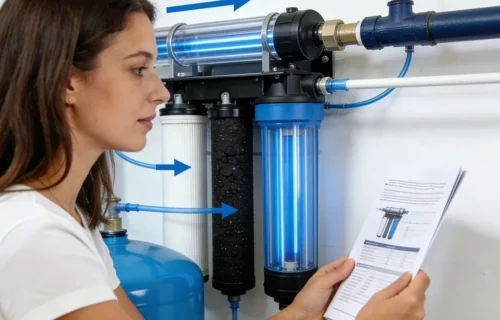
Modern reverse osmosis units are often installed beneath a kitchen sink and connected to a dedicated drinking-water faucet. This approach can provide highly treated water where it matters most without requiring every gallon used in the home to pass through the same process.
Of course, reverse osmosis systems have their own maintenance requirements. Filters and membranes need periodic replacement, and installation should be handled properly to ensure reliable operation.
What About Alkaline Water?
Alkaline water has also attracted plenty of attention in recent years. Some homeowners like the taste and prefer water with a higher pH, while others are simply curious about the technology.
Alkaline water filters can be designed to adjust the characteristics of filtered water, depending on the particular system. However, it’s wise to keep expectations realistic. Marketing claims around alkaline water can sometimes run ahead of strong scientific evidence.
For most people, the bigger priority should remain straightforward: safe, good-quality drinking water that tastes pleasant and is properly treated for the household’s actual needs.
There’s nothing wrong with wanting more, but it helps to know what a system can realistically deliver.
Maintenance Is Part of the Equation
Buying a water treatment system is only the beginning. Maintenance plays a surprisingly important role in performance.
Filters eventually become saturated. Softener components may require attention. Reverse osmosis membranes don’t last forever. Ignoring these basic requirements can reduce effectiveness and, in some cases, create new problems.
Before choosing a system, ask about replacement schedules and ongoing costs. Find out which components need regular servicing and whether replacements are easy to obtain.
A system that looks inexpensive at first may become less attractive if its replacement parts are costly or difficult to find. On the other hand, a slightly more expensive system with straightforward maintenance may prove easier to own over several years.
Think About Your Whole Household
Water treatment should fit your lifestyle.
A small household that mainly wants better-tasting drinking water may be perfectly happy with a kitchen filtration system. A larger family dealing with persistent hard-water buildup could benefit more from whole-home treatment.
Think about how much water you use, where problems are most noticeable, and what you actually want to improve. Do you care most about protecting appliances? Better shower water? Drinking and cooking? Fewer mineral deposits?
There’s no prize for installing the biggest system available. The best solution is the one that addresses your needs without creating unnecessary complexity.
Professional Advice Can Remove the Guesswork
If you’re unsure where to begin, professional water testing and consultation can make the process much easier.
A knowledgeable specialist can look at water conditions, household usage, plumbing layout, and treatment goals before recommending equipment. That doesn’t mean homeowners should blindly accept the first recommendation they hear. Ask questions. Compare options. Understand what you’re paying for.
A good professional should be able to explain the reasoning in plain language.
If the explanation sounds like a science lecture designed to confuse you, that’s probably a sign to slow down and ask for clarification.
A Better Water Routine Starts With the Right Choice
Water treatment isn’t about finding one magical device that solves everything. It’s about matching the right technology to the right problem.
For some homes, reducing hardness will make the biggest difference. For others, drinking-water filtration may be the priority. Some households may want a combination of approaches to address different needs throughout the property.
The good news is that homeowners have more choices than ever. With proper testing, realistic expectations, and a little attention to maintenance, it’s possible to build a water-treatment setup that feels less like another household project and more like a quiet improvement you appreciate every day.
Because ultimately, that’s what good water treatment should do. It should work in the background, make daily life a little easier, and give you one less thing to worry about.