A Practical Guide to Choosing the Right Water Filtration for Your Home
Water quality is one of those household issues that can stay completely unnoticed until something changes. Maybe the water develops a metallic taste. Perhaps there’s orange staining around the sink, a strange smell from the shower, or a chalky film that seems to appear overnight. Sometimes the concern is less obvious, which is exactly why understanding your water matters.
The good news is that you don’t have to become a water-treatment expert to make a sensible decision. Start by testing the water, understand what’s actually present, and then choose equipment designed to deal with those specific conditions. It sounds simple, and honestly, it often is.
Start With a Water Test
Before shopping for filtration equipment, find out what you’re trying to remove. Water from a municipal supply and water from a private well can have very different characteristics.
A basic water analysis may check hardness, pH, iron, manganese, chlorine, dissolved solids, and other common factors. Depending on the location and water source, additional testing may be appropriate.
This step is easy to skip. People see a filter advertised for “clean water” and assume it will solve everything. But water treatment doesn’t really work that way. A filter designed for sediment won’t necessarily address dissolved minerals, and a softener isn’t designed to remove every contaminant.
Think of testing as getting the diagnosis before buying the remedy.
When Iron Becomes a Household Problem
Iron is naturally present in many groundwater supplies. In small amounts, it may not seem like a major concern, but elevated iron can create a surprisingly long list of annoyances.
Orange or reddish stains on sinks and toilets are a common giveaway. Water may also have a metallic taste, and laundry can develop unpleasant discoloration. In some situations, iron can contribute to buildup inside plumbing and fixtures.
The right iron filter systems can help reduce iron depending on its form and concentration. That’s an important point because not all iron behaves the same way in water. Ferrous iron, ferric iron, and iron associated with bacteria may require different treatment approaches.
A proper water test helps determine which technology makes sense rather than leaving you to guess.
Arsenic Requires a More Targeted Approach
Arsenic isn’t something you can identify simply by looking at or tasting your water. That’s why testing is particularly important in areas where naturally occurring arsenic may be a concern.
Private wells deserve special attention because groundwater chemistry can vary considerably from one location to another. If testing shows elevated arsenic, the treatment approach needs to be chosen specifically for that contaminant and the water chemistry involved.
Modern arsenic reduction systems are designed to reduce arsenic concentrations using technologies selected according to the type and level of contamination. Installation should be based on reliable test results, and follow-up testing can help verify that the system continues to perform as intended.
This is one area where shortcuts aren’t worth taking. If a contaminant can’t be seen, smelled, or tasted, testing and proper system selection become even more important.
Hard Water Is a Different Kind of Problem
Hard water usually isn’t talked about with the same urgency as contaminants such as arsenic, but homeowners know how irritating it can be.
Calcium and magnesium can create scale on faucets, showerheads, water heaters, and other surfaces. Soap may not rinse as cleanly, laundry can feel stiff, and glassware sometimes comes out of the dishwasher looking cloudy.
A water softener can reduce hardness by exchanging calcium and magnesium ions for sodium or potassium ions, depending on the system. The result can be less scale and better performance from soaps and appliances.
However, softening and filtration aren’t the same thing. A softener is designed primarily for hardness, while filtration technologies target different substances.
Combining Treatment Technologies
Some homes have more than one water-quality issue. A household might have hard water along with sediment, iron, or an unpleasant sulfur odor. In that situation, one piece of equipment may not be enough.
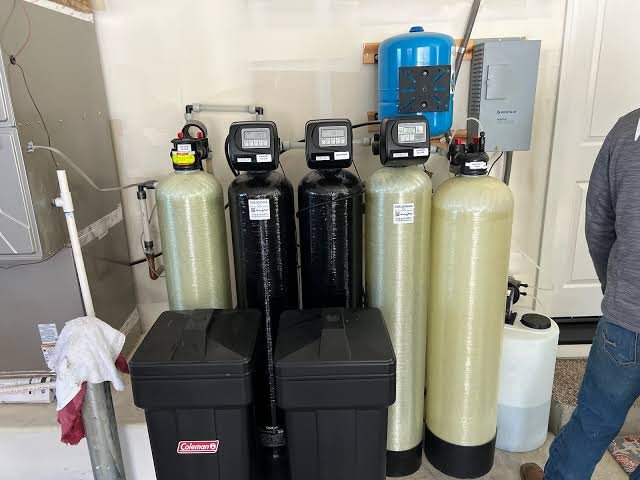
This is where a combination approach can make sense. Depending on the test results, homeowners may use softeners & filter systems together to address separate water-quality concerns.
For example, a whole-home filter could handle sediment or certain unwanted substances while a softener manages hardness. Drinking water might then receive additional treatment through a dedicated point-of-use system.
The key is to avoid installing equipment simply because it sounds impressive. Every treatment stage should have a reason for being there.
Whole-House or Point-of-Use?
Another decision is where treatment should happen.
Whole-house systems treat water as it enters the home. This means showers, laundry, bathrooms, and kitchen taps can all receive treated water. This approach can be useful when the concern affects the entire household water supply.
Point-of-use systems, on the other hand, treat water at a particular faucet or appliance. Reverse osmosis systems are commonly installed under kitchen sinks when homeowners want additional treatment for drinking and cooking water.
Neither approach is automatically better. It depends on the problem you’re solving.
If hard water is the issue throughout the house, treating only the kitchen faucet probably won’t help with scale in the shower. Likewise, if your main concern is drinking-water quality, a smaller point-of-use system may be sufficient.
Don’t Ignore Maintenance
Buying the right system is only half the job. Maintenance matters.
Filters eventually become loaded with the substances they’re designed to remove. Softener settings may need adjustment, salt levels need attention, and certain components require periodic inspection.
A neglected system can lose efficiency, and in some cases, poor maintenance can create additional water-quality problems.
Before purchasing, ask how often filters need changing, what replacement parts cost, whether professional servicing is required, and how easy it is to get those parts. A system that looks affordable on installation day may become frustrating if replacement components are difficult or expensive to obtain.
Make the Decision With Evidence, Not Guesswork
Water treatment can feel complicated because there are so many technologies, product claims, and recommendations floating around. Strip away the noise and the decision becomes much clearer.
Test the water first. Identify the actual problem. Choose treatment technology that matches those results. Consider water usage, installation requirements, maintenance, and long-term costs.
And if someone recommends an expensive system without explaining what it removes or why your home needs it, ask more questions.
Clean, reliable water doesn’t necessarily require a complicated setup. Sometimes the best solution is surprisingly straightforward. What matters most is that the equipment is properly matched to your water and maintained over time.
After all, good water treatment isn’t about having the most equipment in the basement. It’s about turning on the tap and knowing the water coming out is being treated for the things that actually matter.